
Project Description
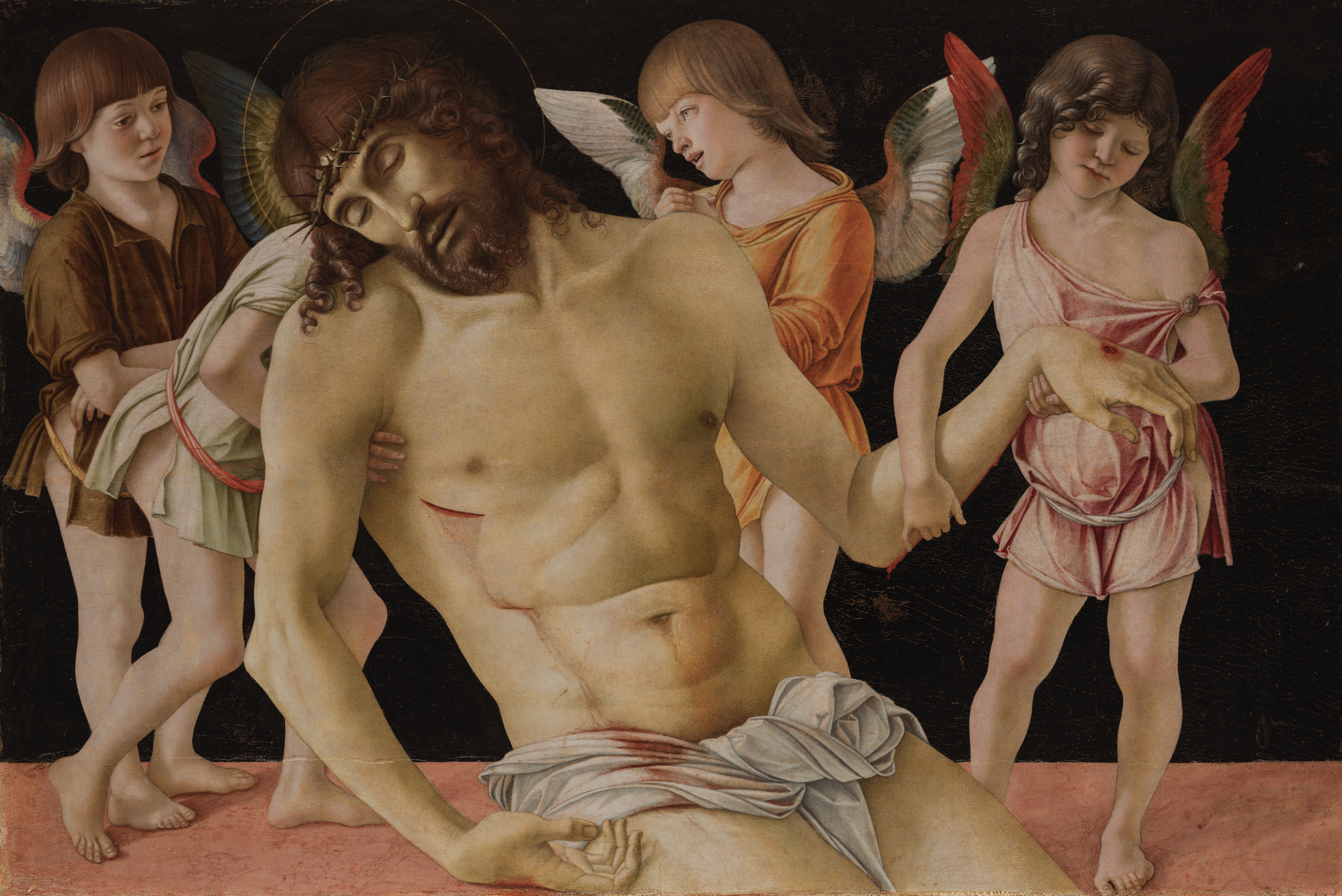
Pietà (Dead Christ supported by Four Angels), Giovanni Bellini, 1470 ca.
Museo della Città di Rimini “Luigi Tonini”, Rimini
Project
Restoration of the Pietà (Dead Christ supported by Four Angels), Giovanni Bellini, 1470 ca.
Location
Museo della Città di Rimini “Luigi Tonini”, Rimini
Project Director
Soprintendenza Archeologia, Belle Arti e Paesaggio per le province di Ravenna, Forlì-Cesena e Rimini
Contractor
C.B.C. – Conservazione Beni Culturali
Senior Supervisor
Sonia Revelant
Funding
François Droulers
Marco Voena
Start date
Agosto 2025
End date
Novembre 2025
Cost
52.000,00€
Venetian Heritage, with the generous support of François Droulers and Marco Voena, has funded the restoration of Pietà (Dead Christ Supported by Four Angels) by Giovanni Bellini, painted around 1470 and housed at the Museo della Città “Luigi Tonini” in Rimini.
The panel was probably commissioned by Rainerio di Lodovico Migliorati, a refined humanist and counsellor to the Malatesta family. Initially destined for the family chapel in the now-lost church of Sant’Antonio Abate in Rimini, the Pietà was later placed in the nearby Tempio Malatestiano after Rainerio’s death and eventually entrusted to the Municipality of Rimini between 1805 and 1851.
In this work, Bellini reinterprets the traditional Byzantine theme of the Imago Pietatis, transforming it into an image of profound humanity and contemplation. At the center of the composition dominates the half-length figure of the lifeless Christ, his body bearing the marks of the Passion — the nail wounds, the gash in his side, and the crown of thorns upon his head. The scene does not depict a specific episode from the Gospels: it ideally lies between the Deposition and the Resurrection, existing in a timeless dimension designed to invite the viewer to meditate upon the divine mystery.
Surrounding Christ’s body, four angelic youths share in the sorrow, gazing at his wounds with tender compassion. One of them, in the foreground, gently supports the body to prevent it from falling backward — a gesture more symbolic than practical, yet charged with deep emotion.
The Pietà has a long and complex conservation history. The first major restoration, by Mauro Pellicioli, was completed in 1929, prior to the great London exhibition on Italian painting, where the work was displayed. Pellicioli restored it again in 1949, but the most significant intervention occurred in 1969. Due to the severe deterioration of the original wooden panel, Otello Caprara and Ottorino Nonfarmale were forced to remove the paint layer and transfer it onto a new fiberglass support reinforced by an aluminum honeycomb structure. Though highly invasive and risky, the operation was executed with exemplary skill, ensuring the preservation and survival of the painting.
The recent restoration, conducted by CBC – Conservazione Beni Culturali, focused instead on meticulous maintenance and aesthetic revision. The goal was to recover the painting’s visual balance and chromatic harmony, primarily through the removal of the heavily yellowed varnish applied during the 1969 treatment.